Detroit’s Case for Reparations
How one city is challenging what we think we know about repair

Come to Detroit, and Ms. Etta Adams will challenge what you think you know about reparations. With the gentle authority of a community elder, she tells a story of harm still unfolding today.
Ms. Adams is among countless Detroiters subjected to predatory taxation in the wake of the 2008 financial crisis. Inflated property assessments drove up tax bills—especially in Black neighborhoods—in violation of state law. Like tens of thousands of her fellow residents, she was unable to keep up with those unlawful taxes, and the city took her home through tax foreclosure. Conservative estimates suggest this wave of foreclosures stripped between $600 million and $1 billion in wealth from Detroit residents—making it one of the largest seizures of Black wealth in our country’s history.
Ms. Adams is also among a coalition of Detroiters working to fix the system and seek redress. Hundreds of kindred reparative justice efforts across the country are quietly gaining traction, even in a difficult political climate. But the deeper barrier is cultural—sustained by misconceptions about what reparations are, how they work, and what they are meant to achieve.
Pay attention to Ms. Adams’ story—and to the movement gathering momentum in Detroit—and these myths begin to unravel.
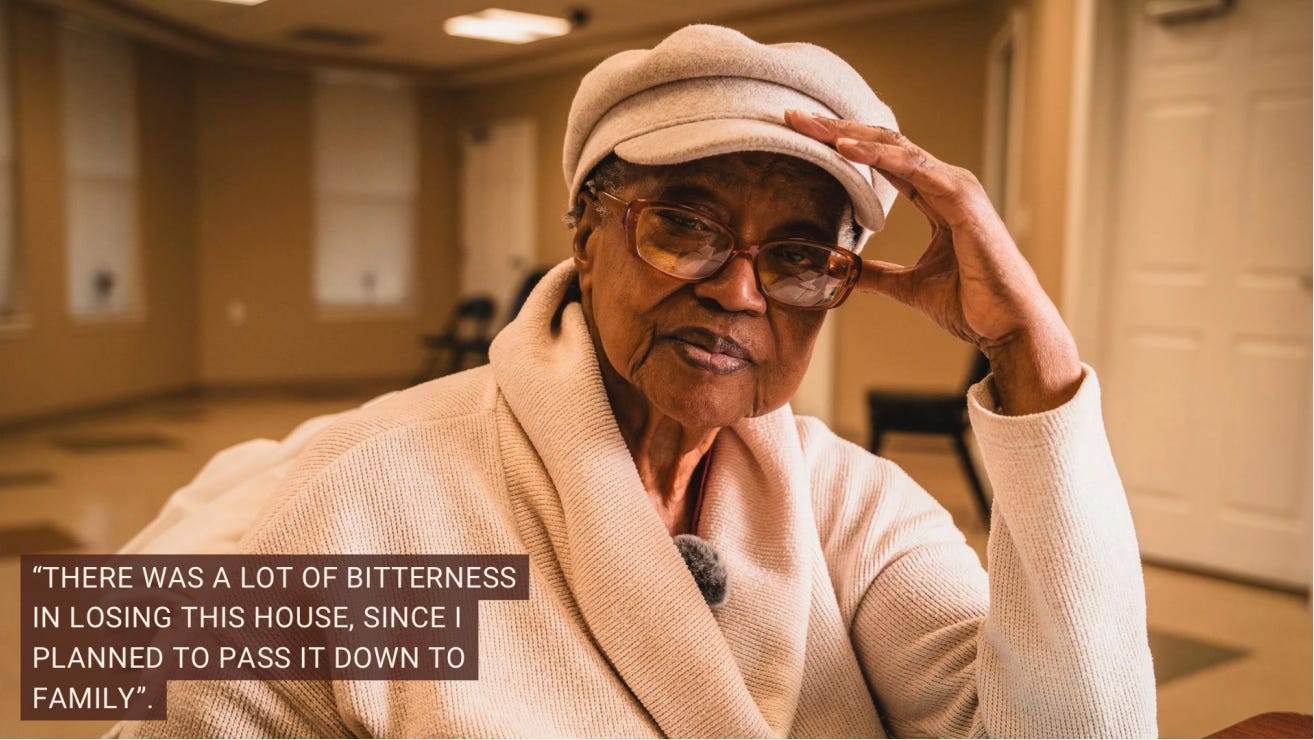
Photo credit: Val Waller
Myth 1: “Reparations are compensation for slavery”
Ms. Adams looks back at the city’s seizure of her home as part of a pattern of plunder that has unfolded over generations. In the 1950s, her childhood neighborhood in Detroit—Lafayette and Hastings—was marked for “urban renewal.” It was a place alive with storefronts, barbershops, and music that spilled into the streets, part of a broader district where Black families built businesses and community in the face of exclusion elsewhere. When the state pushed an interstate highway through its center, her parents received no compensation. Homes were taken, businesses shuttered, and a neighborhood that had taken decades to build was erased in a couple years. For Ms. Adams and her family, this was an intergenerational setback—a home and community she could not inherit, would have to rebuild, only to lose it again.
Ms. Adams is a genealogical researcher who knows her lineage and carries that history with clarity. Reflecting on the seizure of her home—and of her parents’ home—she reaches even further back across generations, across the Atlantic: “We were brutally removed from our homeland. That means we had a language, we had a culture, we had family.” The repair she seeks is not for a list of grievances too long to count. She is trying to interrupt a pattern of theft that persists today.
I met a racial justice advocate last year who had helped steer her family foundation toward funding racial equity work. As a trustee, she noticed an increase in proposals from the growing reparations movement and ultimately decided not to fund them. “Reparations are backward-looking,” she told me. “We are investing in a more equitable future.”
I countered with intellectual arguments: that reckoning with racial harms of the past is the foundation for a thriving multiracial democracy; that from enslavement, to Jim Crow, to redlining and blockbusting, and now to predatory taxation in Detroit, each chapter has contributed to today’s racial wealth gap—and that we cannot solve that problem without disrupting the pattern of theft.
Those arguments didn’t move her. But Ms. Adams’s story might—framing reparations as a reckoning with the past that helps carry us toward the country we aspire to become.
Myth 2: “Reparations are a financial transaction”
“The home I lost was more than just a structure; it was a vessel for community,” Ms. Adams told me. A relative had bought it for her in cash—a place she hoped to pass down to her son. In the yard, she had cultivated what she called the “Mother’s Peace Garden,” a space where women gathered to plant and to pray. “It developed a whole other energy on the street,” one neighbor told her.
Ms. Adams’ loss is not something money can replace: belonging, identity, community. She didn’t just lose an asset, she lost a piece of herself. “I felt ashamed and inadequate,” she said, “like I had let down my son and my ancestors.”
That sense of shame was reinforced by the way the crisis was explained. As legal scholar Bernadette Atuahene has documented, many public officials framed Detroiters as personally irresponsible—people who didn’t want to pay their taxes. One even suggested that residents chose to spend money on purses instead of paying their tax bills.
These narratives not only misdiagnosed the problem; they also shifted blame onto those who had been harmed. Many residents internalized that blame, beating themselves up for losing family homes that had been held for generations, even as the city was illegally over-assessing properties.
Atuahene describes this as “dignity taking”—a form of harm that combines material dispossession with the erosion of personhood. And she argues that repair, in these cases, must go beyond compensation. It must restore dignity: recognition, agency, and the ability to move forward without shame.
Money does matter. Ms. Adams is clear about that. “The funds are critical for growth and stability,” she says. But on their own, they are not sufficient. “True repair is about recognition and honesty,” she told me. “It’s about an apology that has never come.”
Myth 3: “Reparations are not possible”
In Detroit, that assumption is already being tested. In just the past few months, the Dignity Restoration Project has begun compensating a small group of residents—its Pioneer Cohort—people who were overtaxed and lost their homes through foreclosure. It is a modest beginning, but a concrete one: documented harm, acknowledged publicly, and met with compensation.
For Ms. Adams, who is part of this Cohort, the impact is personal. “The Dignity Restoration Project has been a balm for my spirit,” she told me. Receiving compensation was more than a financial transaction—it was an affirmation: Yes, we hear you. Yes, we understand your pain. It has given her not only relief, but a renewed sense of agency.
And yet, even as efforts like this begin to take shape, confidence lags. Liberation Ventures calls this the “hope gap”: the distance between believing reparations are justified and believing they are possible. In one analysis, support for reparations among Black Americans is over 70 percent; yet only 7 percent of Black supporters believe reparations are very or extremely likely to happen in their lifetime. (What does it say about a democracy when so many believe justice is warranted, but so few expect it will ever be delivered?)
This is a challenge other movements have faced before. In the early days of the marriage equality movement, nationwide recognition felt similarly out of reach. Then, in 2003, Massachusetts became the first state to legalize same-sex marriage after a state supreme court ruling—an outcome that had once seemed unimaginable. Over the next decade, progress unfolded unevenly: a court decision in Iowa, legislative victory in Vermont, and political breakthroughs in New York. There were setbacks, too—California’s Prop 8—but each win made the issue more difficult to dismiss. By the time the Supreme Court recognized marriage equality nationwide in 2015, it was building on more than a decade of state-level victories that had already begun to shift law and public belief.
A related debate is unfolding within the reparations movement. I saw it play out at a summit last summer, where participants were asked to take a position on whether to continue advocating for a comprehensive national program, or to focus on concrete wins locally—and the room split down the middle. The Dignity Restoration Project offers a different way of approaching that question: start with concrete wins where the harm is clear, and use them to open the way for broader action. By focusing on recent, well-documented harms like Detroit’s unconstitutional overtaxation crisis, it makes repair actionable and within reach—and, in doing so, begins to make national solutions more imaginable.
Roots of repair
If you find yourself feeling sorry for Ms. Adams, consider instead her strength. “I am a woman deeply connected to my roots,” she says. “I carry the stories of my ancestors—from the Yoruba people of Nigeria to the Gullah Geechee of South Carolina—within me.”
She carries a sense of dignity that does not depend on recognition, but insists on it. It is this inner grounding that makes her less vulnerable to the diminishment of unjust systems, and more capable of challenging them.
Perhaps this is where repair begins—not only in what systems are willing to do, but in what people like Ms. Adams uphold within, and are now asking the rest of us to finally acknowledge.
What lies beyond this piece
There are other myths worth exploring—two in particular that I plan to take up in future essays.
Myth 4: “My family came here recently; reparations have nothing to do with us” I’m a child of Indian immigrants and I’ve spent the past several years working in the reparations movement while also grappling with my own place in it. In a conversation so bound up with identity and history, I’ve found myself returning to this question: what role do newer Americans play in reckoning with the history of the country they now call home?
Myth 5: “Reparations won’t make a meaningful impact” This is not simply a myth—it is also an empirical question. The Dignity Restoration Project has partnered with a team of researchers to study the outcomes of its Pioneer Cohort, including participants like Ms. Adams. Their findings, still forthcoming, will help shed light on what repair looks like in practice, and what kinds of change it leads to.